
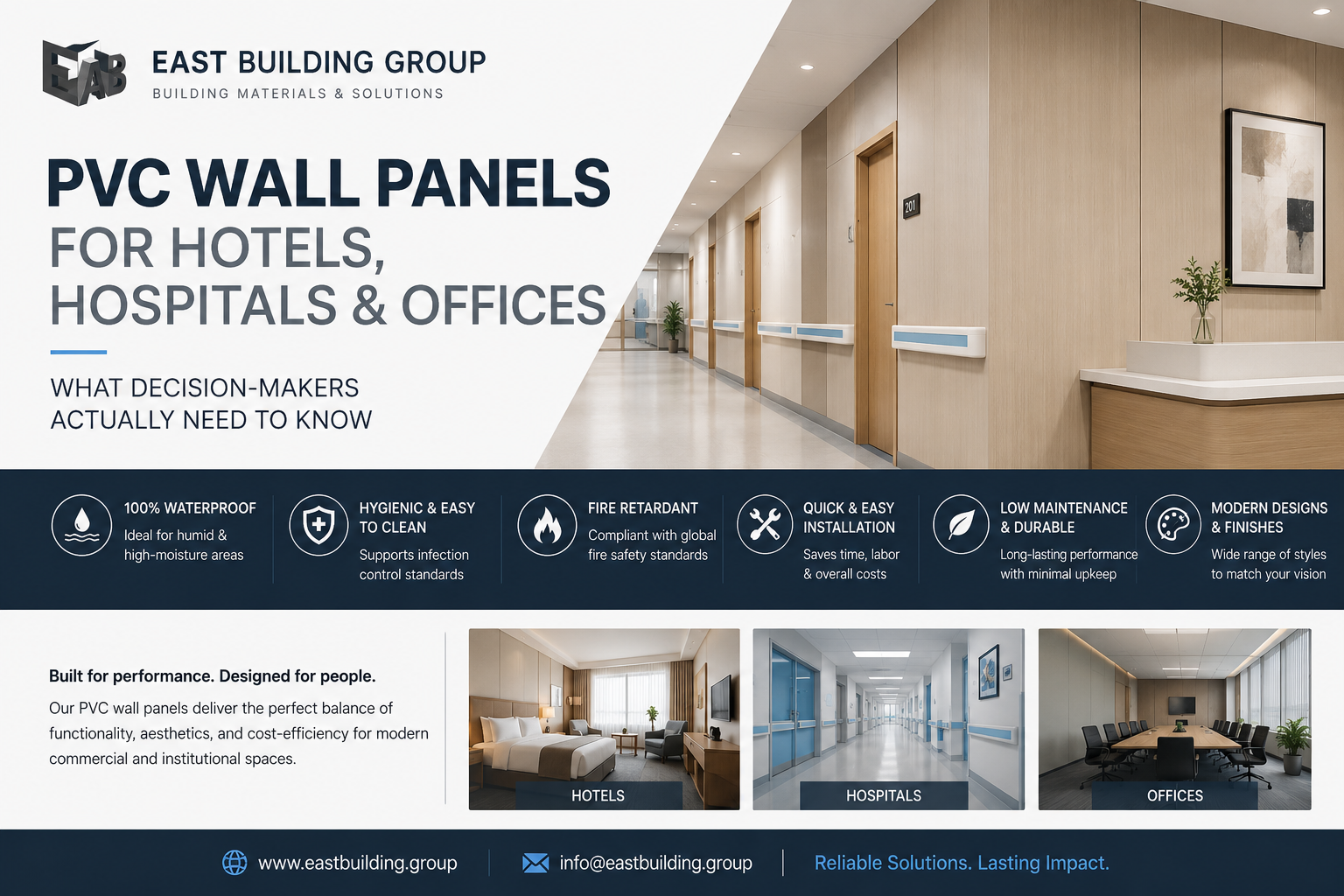
PVC wall panels are a durable, low-maintenance, and cost-effective interior wall solution for hotels, hospitals, and office buildings. They offer moisture resistance, easy cleaning, fast installation, and long service life, making them an attractive alternative to traditional wall finishes such as paint, gypsum board, ceramic tiles, and laminates.
The Real Problem with Traditional Wall Finishes in Commercial Spaces
Paint chips. Tiles break at the grout lines. Plasterboard absorbs water and silently develops mold behind the surface; no one notices it until they do. For a hospital, that’s a hygiene risk. For a hotel, it’s a review. For an office, it is a maintenance budget, which continues to expand quarter after quarter.
Traditional wall materials were constructed in a lower-stress environment. Placing them in a hospital ward, a hotel corridor, or a busy corporate office, the everyday wear and tear are not something that they were designed to scale to. The result? All this repainting, constant repairs, the cost of janitors rising, and the rooms that always appear to look a little fatigued no matter how much effort you put into them.
PVC wall panels were built specifically for this gap.
Why Modern Spaces Are Switching to PVC Wall Panels
Any business area today requires more than just an appearance. It should be durable, low maintenance, and valuable in output. PVC wall panels satisfy all these requirements without complicating it. Businesses are opting to use long-lasting and more efficient solutions instead of repainting or repairing their facilities frequently. These panels are not heavy; they are simple to install and also resistant to moisture, suitable for high-traffic settings.
How Each Industry Benefits Differently
PVC wall panels are not a one-size-fits-all value. Every industry has reasons to trust them.
Hotels: First Impressions That Last Longer
The worst enemy of a hotel is a wall beginning to appear shabby half a year after being renovated. Visitors observe cracking walls, battered corridors, and stains of water around shower rooms – and they comment on it in their reviews. The PVC wall panels have highly glossy, matte, wood-like, and marble finishes, which do not only appear premium on their first day but also perform the same role over the years. Hotel corridors, guest bathrooms, wet poolside areas, and service areas are some of the areas where a material that is simple to wash and difficult to damage and hundreds of design finishes that can be used to suit any interior idea are in place.
Hospitals: Hygiene You Can Actually Verify
Wall surfaces in healthcare settings are not really aesthetic features but rather treated as infection control surfaces. PVC wall panels are non-porous, so bacteria and fungi cannot find a rough surface or grout crack to settle. Antimicrobial additives – silver ion technology – are now incorporated in many variants, and they have the ability to actively inhibit the growth of microbes 24/7. A simple wipe with hot soapy water or a mild cleaner is enough to bring the surface back to clinical standards without bleach or harsh agents that damage the wall finish over time. Patient rooms, operation theaters, corridors, and washrooms – all of these areas benefit directly from a wall material that is designed to stay hygienic under pressure.
Offices: Professional Look, Practical Cost
Modern office design needs to look good, last long, and cost predictably. PVC wall panels enable interior designers to replicate the appearance of wood paneling, concrete-like surfaces, or minimalist finishes at a fraction of the price of real wood and rock. To the facilities teams, the calculation of maintenance is easy: there is no repainting, no regrouting, no special cleaning, only wipe-downs. For co-working spaces and multi-tenant commercial buildings, this translates into significantly lower upkeep costs across the property.
What About Installation and Downtime?
This is where PVC wall panels genuinely outperform almost every alternative. They can be installed in a fraction of the time that tile or drywall would take since their installation systems are interlocking or direct-adhesive. That is critical to hotels that cannot afford to shut down a room for weeks or hospitals that must retrofit a ward without closing down the operations.
The panels are also lightweight, which reduces structural load and makes large-scale installation manageable without heavy equipment.
Conclusion
You need to furnish a new wing of a hotel, refurnish a hospital ward, or remodel a corporate office – the choice of wall solution you make will shape your space over the next few years. Eastbuilding uses the best quality PVC wall panels designed to be used in the identical environment: strong, sanitary, requiring little maintenance, and coming in an extensive selection of finishes to suit any design brief.
Don’t settle for walls that need constant attention. Select a solution that is designed to work and built to last.
FAQ
What are PVC wall panels?
PVC wall panels are interior wall cladding systems made from polyvinyl chloride used for decorative and functional wall finishes.
Are PVC wall panels suitable for hospitals?
Yes. Their smooth, easy-to-clean surfaces make them suitable for healthcare environments.
Why do hotels use PVC wall panels?
Hotels often choose PVC panels for their aesthetics, durability, and low maintenance requirements.
Are PVC wall panels waterproof?
Yes. PVC panels are highly resistant to moisture and water exposure.
How long do PVC wall panels last?
High-quality PVC wall panels can provide many years of service when properly installed and maintained.
Are PVC wall panels better than paint?
In many commercial applications, PVC panels offer greater durability and lower maintenance requirements than painted walls.
Do PVC wall panels require painting?
No. They are manufactured with finished surfaces and typically do not require repainting.
Are PVC wall panels easy to clean?
Yes. Their non-porous surfaces make routine cleaning simple.
Are PVC wall panels cost-effective?
They often reduce long-term maintenance and renovation costs compared to traditional wall finishes.
Which industries use PVC wall panels?
Hotels, hospitals, offices, schools, retail spaces, and commercial facilities commonly use PVC wall panel systems.
