
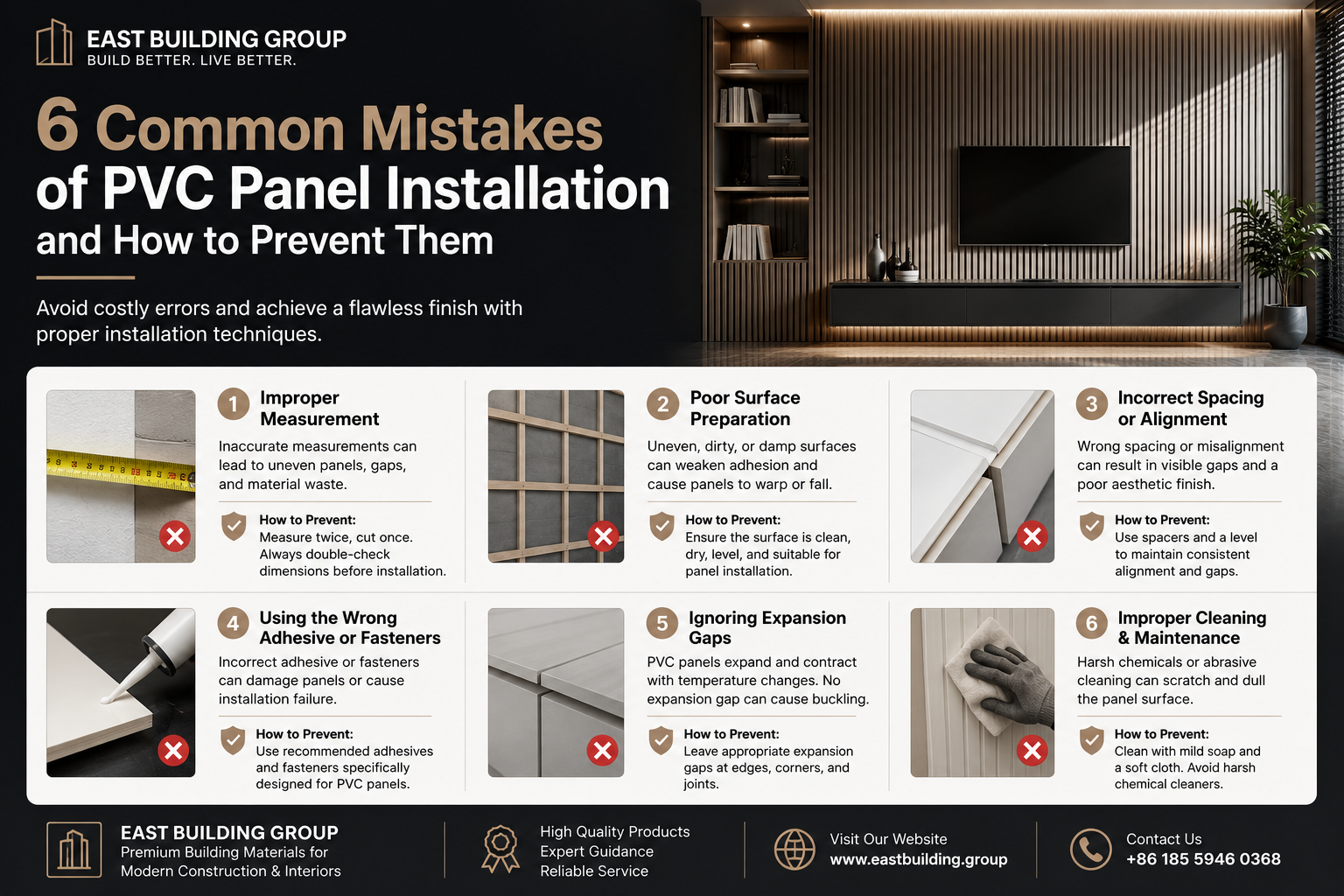
PVC panels are easy to install, affordable, and waterproof. They are developing into a popular choice for businesses and developers. However, they can be installed ineffectively. There are many avoidable mistakes that consumers make that lead to warped panels, panels that are inconsistent, and panels that will not install. The best part is that these problems can be completely avoided. This article will highlight the 6 most common mistakes seen when customers install indoor PVC panels.
Not Preparing the Surface
The most common PVC panel installation mistake is skipping surface preparation because consumers are too excited to start and get the project rolling. Unfortunately, preparation is critical. Because indoor PVC panels adhere best to clean, dry, and smooth surfaced walls, walls that have dust, grease, moisture, and flaking paint will cause the panels to bubble, separate, and peel off in a matter of weeks.
Here is how to properly prepare the surface:
- Ensure the surface is completely clean with no dust, grease, and flaked paint.
- Ensure the surface is completely dry.
- Fill in any inconsistent cracks or uneven areas.
- Sand flush any raised areas.
Perfectly installing PVC wall panels begins with a properly prepared surface.
Not Letting Panels Adjust to the New Environment
Because PVC panels react to temperature changes, panels that come from a warehouse or delivery truck that have been in a cold environment need time to adjust to the temperature of the room that they are going to be installed in. Panels that do not have time to adjust can expand or contract after they are installed. This can cause problems, such as wishing, warping, or gaps at the seams.
What you should do instead:
- Store panels in the room where they will be installed for 24 to 48 hours
- Keep the temperature in the room where the panels will be installed stable
- Keep panels away from heating sources
This will help you avoid problems in the future.
Using Incorrect Adhesives or Fasteners
There are some adhesives that are not suitable for PVC wall panels that are installed indoors. Using the wrong adhesive can cause problems, such as damaging the surface of the panels, not making a bond, or causing discoloration. Some installers rely too heavily on mechanical fasteners, such as screws or nail, and do not use adhesive. This can cause surface damage and a not good installation.
What to do instead of using incompatible adhesives:
- Use PVC-compatible construction adhesives that are solvent-free.
- Adhere to the manufacturer’s guidelines for the adhesive and the fixings.
- Use waterproof adhesives for bathrooms and kitchens.
- Provide an even adhesive pattern, and do not just place the adhesives in the corner.
Selecting the right adhesive for interior PVC cladding is one of the most crucial steps.
Not Leaving Expansion Gaps
Not leaving gaps for expansion is one of the most common mistakes when installing PVC. Out of all the common mistakes, leaving the panels edge-to-edge with no gaps causes the most problems. If PVC panels are installed edge-to-edge with no gaps, the panels will buckle, bow, and push off the wall.
What to do instead of not leaving expansion gaps:
- Leave a gap of 2 – 3mm.
- In areas that receive the most heat (like a room that gets a lot of sun exposure), provide a larger gap.
- Use trim or edge profiles to cover gaps.
Covering gaps with trim or profiles makes a bigger difference in the long term.
Using Random Tools to Cut PVC Panels
A common mistake people make when cutting PVC panels for interior cladding is using random tools to cut the panels. A hack saw, a kitchen knife, or even scissors are among the tools that people have used to cut PVC panels. Using the right tools to cut PVC panel cladding helps to maintain the panels’ integrity and strengthen the panels.
What to do instead:
- Use a handsaw or circular saw to get an accurate straight cut
- For thinner panels, use the score and snap method.
- Measure twice, cut once.
- edges with sandpaper.
Quick Reference: Tools for Cutting Indoor PVC Panels
| Panel Type | Recommended Tool |
| Thin PVC panels (up to 5mm) | Score and snap / utility knife |
| Standard PVC panels (5–10mm) | Fine-toothed handsaw |
| Thick PVC cladding (10mm+) | Circular saw with fine blade |
| Curved or angled cuts | Jigsaw |
Poor Planning and Measurement
Poor planning, and measuring, will usually result in wasted materials with panels that are uneven and an overall poor design. The flaw will be more visible with PVC ceiling panels.
What to do instead:
- Measure the surface area that will be covered with PVC panels.
- Draw the design on paper before starting the project.
- Mark lines with a level and chalk.
- Design from the center of the surface area and work outward.
- Plan around electrical outlets and other wall fixtures.
Proper planning will help in the design and order the correct quantity of panels. Less waste and no expensive re-orders.
What Does a Correct Installation Look Like?
There are distinct results you can see after avoiding installation mistakes. When an indoor PVC panel system is correctly installed, you can see:
- Clean finishing that is aesthetically pleasing and will last
- Panels that resist damage and shifting
- Actual moisture resistance, especially in wet rooms
- Cleaning that is quick and low maintenance
- A professional looking and valuable result for the given space
Because of these results, there is a growing preference for indoor PVC ceiling and wall panels in commercial and residential constructions. The positive results given by PVC panels hinges on a correct installation.
Final Thoughts
Installing PVC panels indoors is a simple process if it is done in the right way. A neat and long lasting result stems from the correct preparation of the surface, a good plan, and the right tools and adhesives. Professionally looking and dependable PVC wall panels for the indoors can be achieved if you pay close attention to the small tricky details that are often the cause of installation woes.
FAQs
Can indoor PVC panels be installed on walls that are not level?
We do not encourage this. An uneven wall will not let the adhesive bond correctly causing the panels to bow and peel. Always level the wall first before installing indoor PVC panels.
How long do PVC panels last indoors?
With the proper installation and minor maintenance, PVC panels indoors can last 10-15 years or even longer. Major factors that contribute to longevity are using proper adhesives and ensuring they are fitted appropriately.
Are PVC panels indoors good for bathrooms and kitchens?
Absolutely! PVC panels are some of the best options for wet spaces. Just ensure that a waterproof adhesive is used and that all the edges are sealed to prevent any water from getting behind the panels.
What is the best adhesive for PVC panels?
A flexible, solvent free adhesive that is rated for PVC is the best option. Always make sure to follow the panel manufacturer’s recommendations.
Do PVC panels need gaps?
Absolutely. PVC does contract and expand with temperature. Leaving an expansion gap of 2-3 mm for each end of a panel run will ensure that the panels do not buckle and will keep the installation looking neat over an extended time.
