
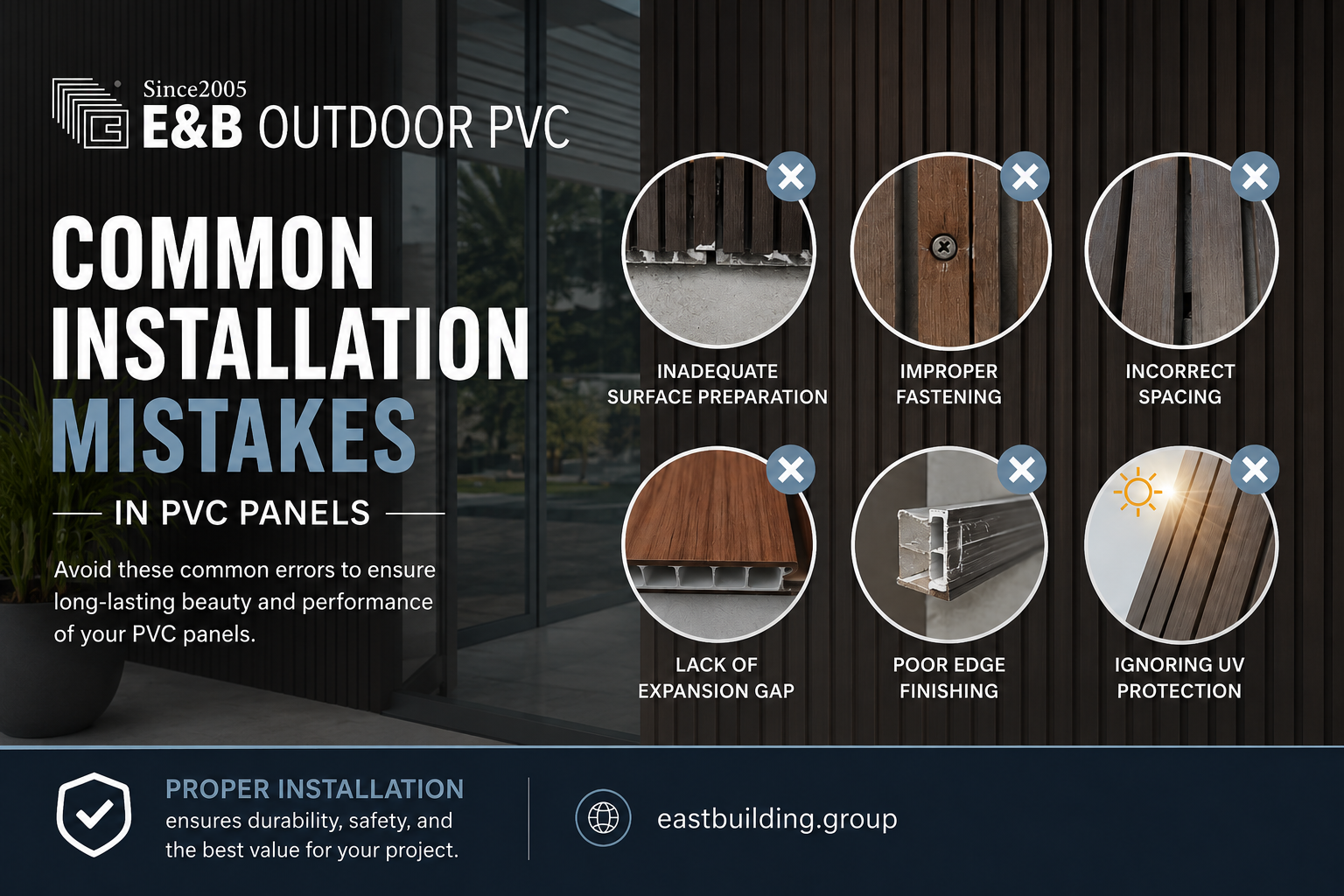
The most common material used on modern interior walls and ceilings is PVC panels. They are lightweight, waterproof, easy to clean, and low cost. PVC wall panels are increasingly becoming a more common choice among homeowners and contractors in kitchens, bathrooms, and commercial spaces. That said, even the best PVC panels can go wrong if they’re not installed properly. Even a minor installation error can cause panels to peel off, warp, or leave uneven gaps. These problems can be very costly and time-consuming to correct after the fact. In this guide, we’ll review the most common installation errors that people make with PVC panels and how to avoid them.
Quick Overview: Mistakes at a Glance
| Mistake | Why It Happens | How to Fix It |
| Skipping surface prep | Rush installation | Clean and dry the wall first |
| Wrong adhesive | Cost-cutting | Use adhesive made for PVC panels |
| No expansion gaps | Lack of technical knowledge | Leave 3–5 mm at edges |
| Poor alignment | Working alone or in a hurry | Use a spirit level and chalk line |
| Ignoring room conditions | Overlooking moisture levels | Acclimatize panels 24–48 hrs before install |
1. Not Preparing the Surface Properly
This is likely to be the most common error. People rush to get the panels up and do not bother with surface preparation. PVC panel adhesive requires a clean, dry, and flat surface to stick. The adhesive will not adhere if the wall is dusty, greasy, old paint, or wet. Within weeks the panels will begin to flake.
What you should do instead:
- Before you begin, thoroughly clean the wall surface.
- Remove any loose paint or wallpaper
- Allow surface to dry thoroughly
- Seal any gaps or uneven surfaces with filler.
The more time you spend on the preparation work, the less time you will spend on the repair work.
2. Using the Wrong Adhesive
Not every adhesive is suitable for use with PVC ceiling panels or wall panels. Some people may opt for using general-purpose glue to save money and find panels falling off within months.
PVC has low surface energy, which makes bonding with standard adhesives difficult. It requires an adhesive that is specially formulated to bond with plastic surfaces. PVC panels may warp or become damaged by solvent-based adhesives; make sure to read the label before using.
Adhesives should be
- Works with PVC materials
- Moisture resistant, particularly for wet areas
- Recommended by the panel manufacturer
3. Skipping Expansion Gaps
PVC panels expand and contract in response to temperature and humidity changes. They cannot move if they are fitted too tightly against walls, skirting boards, or other fixed surfaces. The result? Buckling, warping, and paneling popping out. Always leave a small gap around 3-5 mm around the edges. Fill these gaps neatly with the use of appropriate trims or edging profiles. This is a very easy and effective way to help the longevity of your interior wall cladding.
4. Poor Alignment and Uneven Panels
Crooked panels are a big error, and it is very noticeable. Once the adhesive sets, it is nearly impossible to realign the panels without damaging them. A lot of installers skimp on this part, particularly on large walls. Their initial starting position is incorrect or they don’t use a level, resulting in the panels drifting further and further out of alignment.
To achieve a neat, polished appearance:
- Begin with a plumb vertical line (use a spirit level or chalk line)
- Verify alignment (2-3 panels at a time)
- Assume that any existing walls and corners are not perfectly straight.
Taking a few extra minutes at the start prevents a crooked job at the end.
5. Not Acclimatizing the Panels
This is a surprising one for many. PVC panels need time to acclimatize to the temperature and humidity of the room they will be installed in. When installing a panel directly from a cold warehouse into a warm, humid bathroom, the panel will swell after installation, resulting in swelling, joining gaps, and bubbling. The fix is simple: store the panels in the installation room for at least 24 to 48 hours before fitting. This allows them to acclimatize naturally.
6. Ignoring Moisture in Wet Areas
A PVC panel may be waterproof, but a wall behind it isn’t so. Sealing PVC over existing moisture in the wall (caused by dampness, leaks, or condensation) will create a situation where mold will form behind the panels. When installing PVC ceiling panels or wall panels in bathrooms or kitchens, inspect first for any existing damp problems and then address them. Use appropriate sealants at joints and edges to prevent water from getting behind the panels.
7. Cutting Panels Incorrectly
PVC panels must be cut correctly and using the proper tools. Using a rough saw or cutting too quickly can crack or splinter the edges — leaving rough, unprofessional finishes around windows, doors, and corners.
Best practices for cutting PVC panels:
- Use a fine-toothed handsaw or circular saw with a fine-toothed blade.
- Use a scoring and snapping tool for more precise cuts in thin panels
- Always measure twice before cutting
- Always support the panel fully along its length when cutting to avoid snapping.
Conclusion
Installing PVC panels is a straightforward process, but attention to detail is essential for long-lasting results. Common installation problems can be avoided by proper surface preparation, correct adhesive selection, and allowing expansion gaps, which will enable the professional finish.
With the right materials and careful planning, many installation mistakes are easy to avoid. By following the proven practices of PVC panel fitting, durability, aesthetics, and performance in residential and commercial settings will be enhanced.
Looking for top-quality PVC panels? Contact East Building Group today to find the right solutions for your project and achieve reliable, high-quality results.
FAQs
How do you prepare a wall for PVC panels?
Before installation, clean the surface of the sheet to remove all dust, grease, loose paint, etc. and ensure it is smooth and dry.
Can PVC panels be installed directly on a wet wall?
No. Only PVC panels can be installed on surfaces that are dry, because any moisture on the surface can cause mold growth and failure of the adhesive.
Why do PVC panels warp after installation?
Typical causes of warping include insufficient expansion gaps, failure to acclimatize the panels before installation, or the use of solvent-based adhesives that are incompatible with PVC.
What is the best adhesive for PVC wall panels?
Always employ a PVC-compatible, moisture-resistant adhesive; never use solvent-based adhesive, as solvents can harm the panels.
