
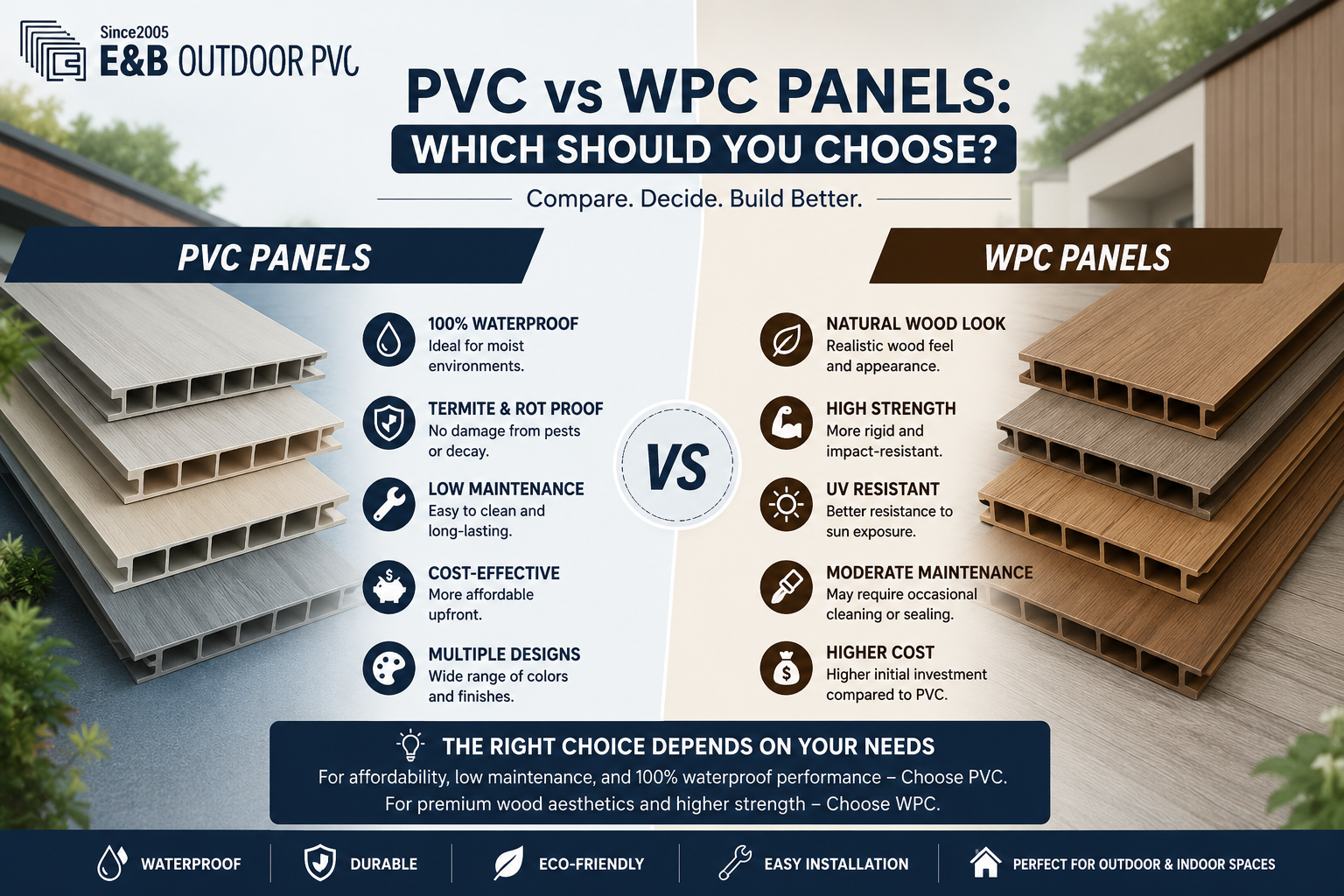
These two materials have a very similar name but a very different outcome depending on where you use them. Contractors and procurement teams often treat PVC and WPC as interchangeable – and that assumption is where projects go wrong. Before your next order goes in, here is an honest breakdown of both materials so you can match the right panel to the right job.
What Makes These Two Materials Different?
It’s all about the difference in composition, and it affects all of this – the feel, the performance, and the longevity of the panel. PVC panels consist of 100% synthetic PVC material, which is non-organic. They are also light, waterproof, and non-porous. PVC panels are not affected by wood fiber and hence do not swell, absorb moisture, or attract insects. This uniformity makes them a predictable and reliable material for use in interior applications.
WPC panels (Wood Plastic Composite) are a hybrid. They are a mix of recycled wood fiber and thermoplastic resins that provide a more rigid and denser structure. This gives it a more natural wood appearance, and it is more suitable for temperature fluctuations and physical rigging. WPC is generally thicker than normal PVC panels and therefore has a higher impact resistance.
Cost: Where Each Material Stands
In most B2B purchases, the initial filter is budget, and the difference between these two materials is quite real. The most affordable option is PVC panels. The material cost is between $1.80 and $3.20 per square foot, and they are lighter than WPC, which leads to a 20 to 30% reduction in installation time. For the larger commercial projects, where quantity is important, this represents considerable time savings in labor.
The manufacturing process for WPC panels makes them more expensive, usually $2.50-$4.00 per sq ft. But over time, the cost picture changes:
- WPC panels have a lifespan of 15 to 25 years for outdoor use
- They are more resistant to damage to the surface and scratches in high-traffic areas.
- Maintenance needs are low, and costs are up to 30-40% less for maintenance over 15 years.
WPC’s initial investment is generally higher but can be justified in three to four years for projects where the surface will be exposed to daily use or exposure to the elements.
Durability: Same Category, Different Strengths
Both materials have advantages and disadvantages, and no material is always better – they each work best under certain conditions.
PVC panels are more moisture-resistant. They are 100% synthetic and don’t require treatment to prevent mold, mildew, or moisture absorption. Lab testing shows PVC withstands impact forces up to 50% higher than WPC in controlled conditions, owing to its density range of 1,350 to 1,450 kg/m³. PVC panels are the better choice for wet areas, such as the poolside interior, bedrooms, bathrooms, and food processing areas.
However, WPC panels have a greater resistance to the outdoors or temperature changes. Under changing heat conditions, they have 60% less thermal expansion and contraction than pure PVC because of their wood fiber composition. They are also more UV resistant when co-extruded with coatings and provide more protection against visible surface wear in high-traffic areas.
Which Option Works Best for Your Application?
It really depends on where the panel will be placed and what it will be exposed to on a regular basis.
Use PVC panels when:
- The area is regularly wet.
- Installation time and budget efficiency are key factors.
- Indoor application: kitchens, bathrooms, commercial interiors, healthcare environments
Choose WPC panels when:
- The project involves outdoor or semi-outdoor cladding
- Aesthetic quality and the wood-like finish are client requirements
- The primary issue is the durability, or its lifespan, in high traffic or UV exposure.
Conclusion
Both PVC and WPC panels have a lot to offer; however, only when used in the right setting. The majority of project costs are added later when picking based on price.
Eastbuilding offers high-performance PVC panels that are suitable for use in both indoor and outdoor environments – for B2B projects, we’re willing to provide the support you need and a scale of supply that meets the demands of commercial projects. If you’re looking for guidance on the specifications, volume pricing or product range, we’re here to help. Connect with us today.
FAQs
Which is a better choice for commercial use – PVC panels or WPC panels?
PVC panels offer lower cost and are faster to install, which makes them the preferred material for large-scale, commercial interior applications. WPC is more durable and suitable for commercial use where there is high traffic or in the outdoors.
Do WPC panels require maintenance like wood?
There is no need to paint, seal, or stain WPC panels. They can be kept in good condition by occasional cleaning with soap and water.
Can PVC panels be used outdoors?
They can, but only to a certain extent. UV exposure may result in PVC yellowing and brittleness over time, particularly in warmer climates.
Which panel type has a longer lifespan?
WPC panels also offer a longer rated service life (up to 25 years outdoors) than PVC panels (10 to 20 years depending on conditions and quality).
