
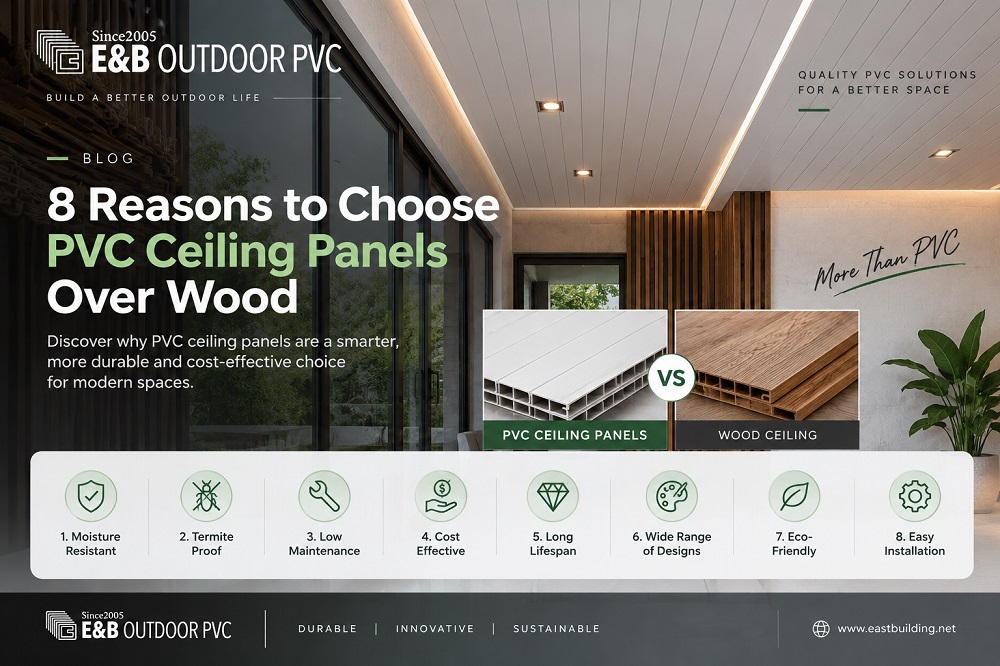
The selection of the appropriate ceiling material has an impact on the appearance, maintenance, installation, and overall cost of a building. For commercial projects, these factors are especially important, since ceilings need to remain functional and aesthetically pleasing over time.
Wood is a favorite due to its natural and warm look. By choosing PVC panels instead of wood, businesses can get a practical combination of durability, ease of care, moisture resistance, and reduced costs.
Let’s look at eight reasons why contractors, manufacturers, and commercial buyers might prefer PVC panels over traditional wood ceilings.
1. PVC Ceiling Panels Offer Better Moisture Resistance
Moisture can damage wood ceilings over time. High humidity and water may cause wood to swell, warp, stain, or rot.
PVC ceiling panels are water-resistant. They do not absorb water like wood. This makes them a good choice for areas with high humidity or frequent moisture.
They work well in commercial kitchens, bathrooms, utility rooms, basements, and other damp spaces. Their moisture resistance can also help reduce repairs and replacements.
2. Lower Maintenance Requirements
In commercial buildings, maintenance is important. Higher costs and staff time are associated with regular cleaning, repairs, and refinishing.
PVC panels are simple to clean. Their smooth surfaces make cleaning easy with simple methods to remove dust and dirt.
Wood ceilings sometimes require more attention to maintain their appearance. They can require sealing, staining, polishing, or refinishing. The quality of care varies according to the finish and the building environment.
A low-maintenance ceiling simplifies maintenance for facility managers. It can also lower the overall work and maintenance expense.
3. PVC Panels Can Reduce Long-Term Costs
The purchase price is only one part of a ceiling project’s total cost. Businesses should also consider installation, maintenance, repairs, and replacement.
PVC panels can help lower costs over time. They are lightweight and easy to install, which may reduce labor costs. They also resist moisture, so they often need less maintenance in suitable areas.
Wood can create a high-end look, but it may cost more to maintain. Regular sealing, staining, or repairs can increase its total cost over time.
When comparing PVC ceiling panels vs wood, businesses should look at the full cost over the panel’s lifespan. The lowest purchase price may not always be the most affordable choice in the long run.
4. Faster and Easier Installation
In commercial construction, project timelines are important. Delays can raise labor costs and push back the opening date.
PVC ceiling panels are light and easy to use. When installed with proper supports and tools, crews can often set them up quickly.
The lightness of their weight also facilitates their mobility around the job site.
For contractors, faster installations can increase productivity and minimize disruption to the building’s operations.
5. More Design and Finish Options
Modern PVC ceiling panels come in many designs, colors, textures, and finishes. This gives commercial buyers more choices than a plain wood ceiling.
Wood-look finishes can add warmth and style without using natural wood. Other finishes can create a clean, modern, or professional appearance.
PVC panels work well in offices, retail stores, hotels, restaurants, and other commercial spaces. Their design flexibility helps architects and contractors match the ceiling with the overall interior style.
6. Lightweight Construction Makes Handling Easier
Material weight affects transport, handling, and installation. Heavy materials may need more workers and equipment during construction.
PVC ceiling panels are usually lighter than many wood-based options. This makes them easier to carry, move, and install on a job site.
For large projects, lighter materials can help workers complete tasks faster and more efficiently.
However, buyers should choose panels based on the project’s structural needs, installation system, and building standards.
7. Better Suitability for Humid Commercial Environments
Many commercial buildings have high humidity. Restaurants, washrooms, indoor pools, coastal properties, and some industrial sites may expose ceilings to moisture on a regular basis.
Wood can warp or become damaged if it isn’t properly selected, sealed, and maintained. PVC offers a practical alternative because it does not absorb moisture in the same way.
This makes PVC a useful choice for businesses that need ceiling materials for damp or humid indoor spaces.
Product selection is still important. Buyers should check the manufacturer’s specifications and confirm that the product suits the planned application.
8. Easier Replacement and Project Flexibility
Commercial ceilings may require repairs due to damages, renovations, or upgrades of electric or mechanical equipment.
PVC panels can facilitate this process. Using the appropriate installation system, one may be able to replace one panel at a time. It will be useful if some parts of the ceiling require repairs.
PVC panels are produced in many varieties and sizes. It will be convenient for the companies that plan to change their interior but do not want to change the ceiling.
It is another advantage of the panels for the construction companies.
PVC Ceiling Panels vs Wood: Which Is Better for Your Project?
No ceiling material is right for every building. Wood is a good choice when you want a natural look, a high-end interior, or a special design.
PVC may be a better choice when you need moisture resistance, easy cleaning, fast installation, and lower costs.
Before you choose, think about the building’s environment, moisture levels, design, installation process, maintenance needs, and budget. Comparing these points will help you select the right ceiling system for your project.
What Should B2B Buyers Check Before Purchasing PVC Ceiling Panels?
While ordering, the commercial customer should consider some points. These checks can save on delays and extra costs and product troubles.
- Quality: check the panel material, strength, and overall build.
- Size: Make sure that length, width & thickness are suitable to the project.
- Finish: Review the different colors, textures, and wood-look finishes.
- Resilience: How do the panels perform when exposed to moisture, heat, impact, and everyday use?
- Installation: Confirm the panels are compatible with your ceiling type and installation method.
- Supplier reliability: Check the reliability of the supplier’s production and delivery.
- Documentation: Request technical information prior to purchase.
- Compliance: Make sure all panels meet project & industry standards.
- Packaging: Ask about the packaging method the supplier uses to send the panels.
- Lead Time: Make sure large orders are produced and delivered on time.
- Customization: If necessary, talk about any custom sizes, colors, or finishes.
- Quality control: Ask the factory to inspect the product and perform testing.
- Support: Make sure the supplier offers good technical support.
A reliable supplier will provide product information, quality assurance, and support from the time the order is placed until the product is delivered.
Conclusion
In many commercial environments, PVC ceiling panels are a viable choice over wood. They are moisture resistant, maintenance-free, and simple to install. They are also available in a variety of styles and colors.
When considering PVC ceiling panels versus wood, consider more than just the initial cost. Take into account installation time, maintenance requirements, room conditions, aesthetics, and usage. These considerations will assist you in selecting the best choice for your project.
Businesses looking for PVC ceiling solutions can consider Haining East Building Group. The company provides the PVC building material and ceiling products that are required for various projects. Buyers can reach out to the supplier to understand the product and project needs.
FAQs
1. Why is Haining East Building Group a good choice for PVC ceiling panels?
Haining East Building Group is a potential choice for B2B buyers who are looking for PVC building material solutions. The supplier can communicate directly with the buyer about the product specifications, finishes, and project requirements.
2. Are PVC ceiling panels better than wood for humid areas?
Untreated wood is not as water-resistant as PVC panels. PVC panels can be a viable option for bathrooms, kitchens, and other humid commercial areas.
3. Are PVC ceiling panels easy to maintain?
In general, PVC panels have smooth surfaces, which are easy to clean, and they require less maintenance than wood that needs frequent refinishing.
4. Can PVC ceiling panels look like wood?
Absolutely, there are wood-look textured and finished PVC ceiling panels. They can deliver a decorative look and the practical attributes of PVC.
