
Your procurement team just shortlisted two materials. The cost sheets look different. The lifespans look different. And your project timeline is ticking. Before you sign off on the wrong cladding choice, here is a comparison that cuts through the surface — literally. When it comes to exterior and interior wall cladding for commercial builds, the debate between PVC panels and wood cladding is not just about aesthetics. It is about total cost of ownership, maintenance cycles, structural performance, and what your clients will be dealing with five, ten, or twenty years from now.
Cost Comparison
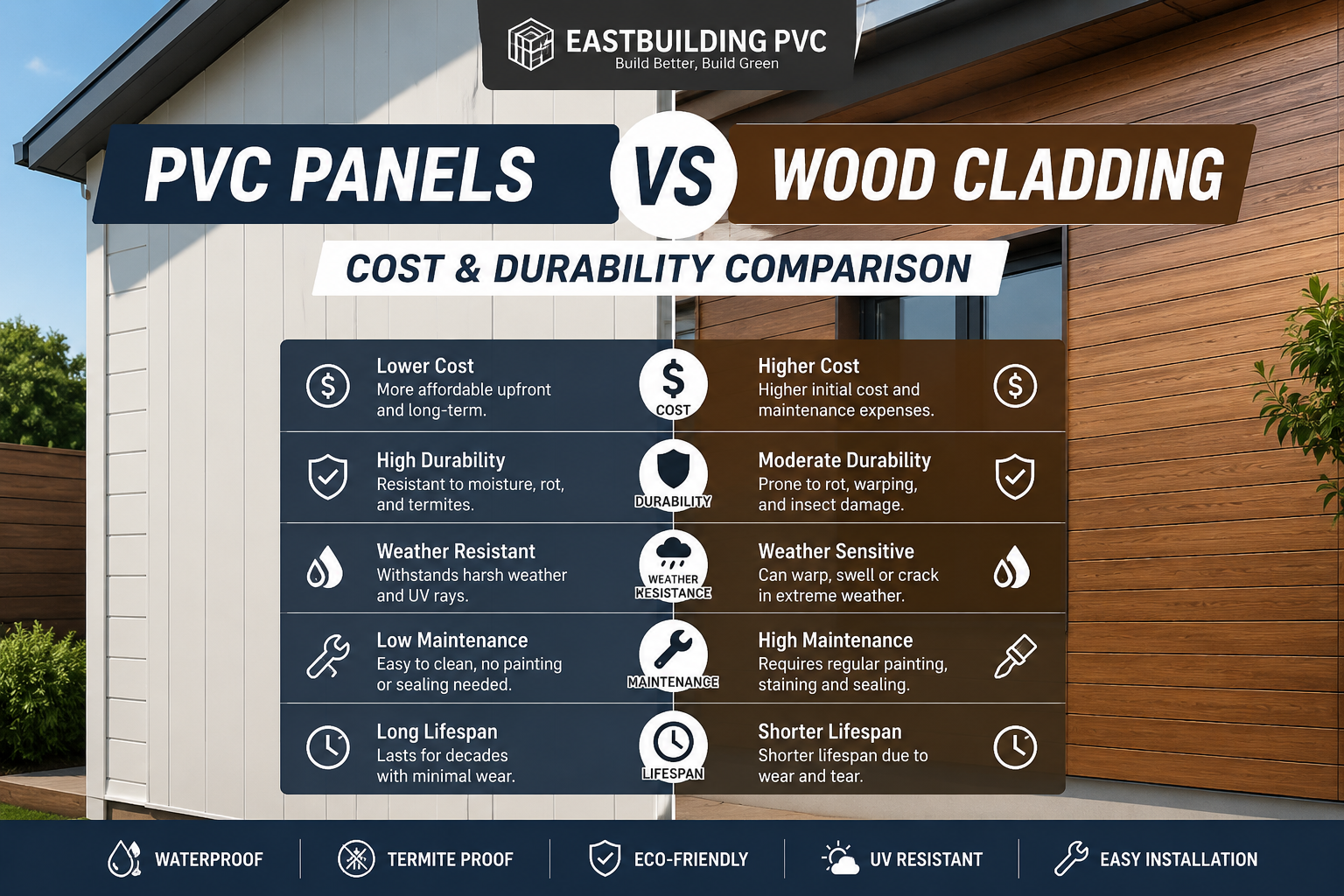
When it comes to B2B construction cost decisions, it’s not just about the initial price tag, and this comparison is a testament to that. The price of PVC panels usually depends on their thickness, finish, and brand and ranges from $1 to $10 per square foot. Low installation costs are achieved due to the interlocking tongue and groove panels, which can reduce labor costs by up to 40% compared to conventional wood installation.
Wood cladding, on the other hand, varies from $2.50 to $12 per square foot in terms of material costs. But that’s just the beginning number. Wood requires:
- Sealing and painting annually 1 to 2 times a year
- Will treat for termites and pests at regular intervals.
- The surface will weather and needs to be repainted or refinished
- If the construction is exposed to water in humid climates, it can be replaced with warped or rotten boards.
The maintenance needs can also make the price of wood cladding appear much more expensive than it actually is in the long run over its 15-year life cycle.
Durability Comparison: Which Material Lasts Longer?
The two materials differ most obviously in terms of durability, particularly for commercial uses and when surfaces are affected by daily use.
PVC panels are resistant to water, non-porous and will not be damaged by mold, mildew or termites. They are not affected by moisture and won’t swell, warp, or rot when wet — an important attribute for exterior cladding in humid or rainy climates. They usually have a life span of 10 to 25 years in the interior, and they can survive up to 40 years if installed properly.
Wood cladding provides excellent thermal insulation, and natural structural strength is important in some project types. But untreated or poorly maintained wood can be subject to:
- Absorption of moisture, warping and cracking.
- Insect damage and rot in humid climates.
- Surface fading and degradation with prolonged UV exposure
If treated and maintained properly, high-quality wood cladding can be long-lasting, but this requires consistent investment that many B2B clients are not prepared to put into their operational budgets.
Material Selection: Choosing the Right Material for the Right Space
Not all projects require the same solution. It will depend on the location and application of the cladding.
PVC panels are a better fit for:
- Wet or high-humidity areas (bathrooms, kitchens, basements, pool areas)
- High-traffic commercial areas that demand easy-to-clean surfaces.
- When installation speed and labor cost are important for large-scale projects.
- Clients seeking minimal maintenance throughout the building’s lifespan
Wood cladding is suitable for:
- Spaces where natural warmth, acoustics and authentic texture of grain are a design priority
- Luxury residential or hotel furnishings
- Dry, climate-controlled environments, with structured maintenance plans.
Conclusion
PVC panels are a more affordable option than conventional wood cladding for businesses that prioritize longevity, low maintenance, and cost savings. They minimize maintenance stress, and they work best in humid environments, as well as modern finishes for commercial interiors.
For commercial or interior applications, select high-grade PVC panels from Eastbuilding for consistent performance, stylish aesthetics and durability. Talk to Eastbuilding today to upgrade your space with enduring wall solutions for today’s business.
FAQs
Are PVC panels cheaper than wood cladding in the long run?
Yes. While PVC panels are more expensive upfront, they require very little maintenance, whereas wood panels must be sealed, stained and treated for pests regularly for a minimum of 10 to 15 years.
Can PVC panels be used for exterior cladding?
Yes, PVC panels can be used outside. They are moisture resistant, UV resistant and insect repellent; in very hot or sunny conditions, they can absorb more heat due to darkness, which may be preferable for some colors and may need special UV-resistant formulations.
Does wood cladding last longer than PVC panels?
Not necessarily. Wood can last for decades if it is properly maintained, but it requires regular maintenance. The life expectancy of PVC panels is 25 – 40 years and requires very little maintenance, making it very competitive.
Which is better for a commercial building project?
In busy, damp environments, PVC panels are generally more preferable for commercial projects because of their durability, speed of installation, moisture resistance, and uniformity over time.
